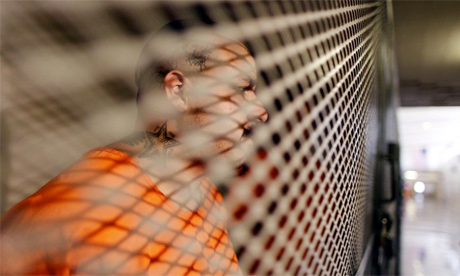
Solitary plea: California has a prison population of approximately 145,000 in 33 prisons; thousands recently went on hunger strike for the second time this year to protest solitary confinement conditions. Photograph: Lucy Nicholson/Reuters
Thousands are refusing food to protest for reform of prison authorities' abusive policy of solitary confinement
"No one wants to die," writes Mutope Duguma, imprisoned in Pelican Bay State Prison, Northern California. "Yet under this current system of what amounts to intense torture, what choice do we have? If one is to die, it will be on our own terms." Mutope was among thousands of prisoners on hunger strike across the state to protest conditions in California prisons. Prisoners at Pelican Bay ended their hunger strike last week, after prison officials agreed to review their policies. The strike continues in other prisons.
Nearly 12,000 prisoners began the hunger strike two weeks ago, according to prison officials. Among them were prisoners from California incarcerated out of state in Arizona, Mississippi and Oklahoma who joined the strike in a powerful act of solidarity. According to Todd Ashker, a hunger strike representative in Pelican Bay Security Housing Unit, or SHU, an important aspect of the protests has been that prisoners have united across racial lines. "When people come together and recognise who the real enemy is, who is really the cause of all their problems, they have a lot of power," he says. Prisoners have five core demands, key among which are the abolition of long-term solitary confinement and the reform of the controversial policy of confining prisoners deemed to be gang members.
Protests started with a three-week hunger strike in July at Pelican Bay SHU, where more than 1,000 people are currently detained. They have called themselves "the buried class". The controversial units are used to "lock down" people in long-term solitary confinement, for years and sometimes decades. California is now holding more inmates in solitary confinement than ever before; approximately 3,238 people are detained in these units across the state. Inside SHU, prisoners are caged for at least 22 hours a day in 8x10ft, windowless cells and have no human contact except when guards put shackles on them. In 1995, a US court held that conditions in SHU "may press the outer bounds of what humans may psychologically tolerate". "There's a notion with many people that the worst of the worst are put in Pelican Bay," says Manuel La Fontaine, an organiser with All of Us or None, "but I've got news for people: the worst of the worst is Pelican Bay."
Isolation is state-sanctioned torture. Harvard psychiatrist Stuart Grassian, an expert on the effects of solitary confinement has said, "in some ways, it feels to me ludicrous that we have these debates about capital punishment when what happens in Pelican Bay is a form of punishment that's far more egregious." Pelican Bay is hundreds of miles from home for most people inside the prison, further isolating them from their families, friends and communities. Among the demands of the hunger strike is to be allowed to make a phone call home and send a photo of themselves to their loved ones once a year. That the authorities deny them these rights is indicative of a system that damages not just the person inside prison, but their communities as well.
One of the main reasons prisoners get sent to the units is because prison officials label them as members of a "gang"; this is part of a wider strategy to dehumanise and criminalise members of our communities. The only way to be released from SHU is if a prisoner agrees to give information, or "debrief", about other prisoners or people outside prison, including their own family. Many prisoners are "validated" as gang members with evidence that is clearly false, or fabricated by other prisoners in order to leave SHU themselves. As a SHU prisoner writes, "The only way out is to debrief, die or parole. They want to break us. If this is not torture, I don't know what is." According to figures released by prison officials in August this year, some 500 prisoners in Pelican Bay had spent more than 10 years in SHU confinement and 78 more than 20 years.
"No one wants to die," writes Mutope Duguma, imprisoned in Pelican Bay State Prison, Northern California. "Yet under this current system of what amounts to intense torture, what choice do we have? If one is to die, it will be on our own terms." Mutope was among thousands of prisoners on hunger strike across the state to protest conditions in California prisons. Prisoners at Pelican Bay ended their hunger strike last week, after prison officials agreed to review their policies. The strike continues in other prisons.
Nearly 12,000 prisoners began the hunger strike two weeks ago, according to prison officials. Among them were prisoners from California incarcerated out of state in Arizona, Mississippi and Oklahoma who joined the strike in a powerful act of solidarity. According to Todd Ashker, a hunger strike representative in Pelican Bay Security Housing Unit, or SHU, an important aspect of the protests has been that prisoners have united across racial lines. "When people come together and recognise who the real enemy is, who is really the cause of all their problems, they have a lot of power," he says. Prisoners have five core demands, key among which are the abolition of long-term solitary confinement and the reform of the controversial policy of confining prisoners deemed to be gang members.
Protests started with a three-week hunger strike in July at Pelican Bay SHU, where more than 1,000 people are currently detained. They have called themselves "the buried class". The controversial units are used to "lock down" people in long-term solitary confinement, for years and sometimes decades. California is now holding more inmates in solitary confinement than ever before; approximately 3,238 people are detained in these units across the state. Inside SHU, prisoners are caged for at least 22 hours a day in 8x10ft, windowless cells and have no human contact except when guards put shackles on them. In 1995, a US court held that conditions in SHU "may press the outer bounds of what humans may psychologically tolerate". "There's a notion with many people that the worst of the worst are put in Pelican Bay," says Manuel La Fontaine, an organiser with All of Us or None, "but I've got news for people: the worst of the worst is Pelican Bay."
Isolation is state-sanctioned torture. Harvard psychiatrist Stuart Grassian, an expert on the effects of solitary confinement has said, "in some ways, it feels to me ludicrous that we have these debates about capital punishment when what happens in Pelican Bay is a form of punishment that's far more egregious." Pelican Bay is hundreds of miles from home for most people inside the prison, further isolating them from their families, friends and communities. Among the demands of the hunger strike is to be allowed to make a phone call home and send a photo of themselves to their loved ones once a year. That the authorities deny them these rights is indicative of a system that damages not just the person inside prison, but their communities as well.
One of the main reasons prisoners get sent to the units is because prison officials label them as members of a "gang"; this is part of a wider strategy to dehumanise and criminalise members of our communities. The only way to be released from SHU is if a prisoner agrees to give information, or "debrief", about other prisoners or people outside prison, including their own family. Many prisoners are "validated" as gang members with evidence that is clearly false, or fabricated by other prisoners in order to leave SHU themselves. As a SHU prisoner writes, "The only way out is to debrief, die or parole. They want to break us. If this is not torture, I don't know what is." According to figures released by prison officials in August this year, some 500 prisoners in Pelican Bay had spent more than 10 years in SHU confinement and 78 more than 20 years.


